[Valid Atom 1.0]
Mostrando postagens com marcador JAPÃO. Mostrar todas as postagens

sábado, 1 de outubro de 2011

#news Japan: New Government Maps Show Wide Dispersion of Plutonium and Strontium


Environment, Global News, Health, Politics, Society 
- Ministry of Education Maps of Plutonium and Strontium Show Wide Dispersion of Supposedly Heavy Nuclides (EX-SKF, Sep. 30, 2011):
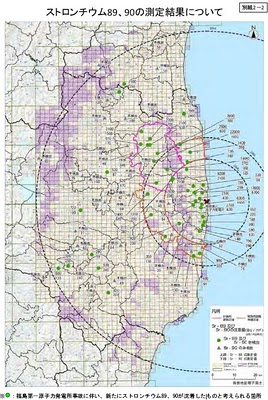
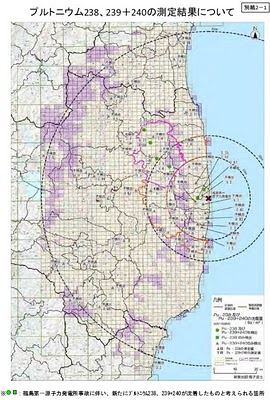
On September 30 the Ministry of Education and Science posted the blurry maps plotting the locations where plutonium and strontium have been detected.
(On the same day, September 30, the national government abolished the evacuation-ready zone between the 20 and 30 kilometer radius from the plant, “allowing” the residents to return.)
The Ministry’s 10-page document is in Japanese only for now.
According to the Ministry, the survey for plutonium and strontium was carried out in early June to early July in 100 locations within the 80-kilometer radius from Fukushima I Nuclear Power Plant by government researchers. One location each in 59 municipalities within the 80-kilometer radius was picked, based on the air radiation level and the high population density. The remaining 41 locations were picked from within the 20-kilometer radius evacuation zones.
The Ministry claims it is the first time plutonium has been detected outside the plant, but all that means is that it is the first time a government ministry has admitted to the existence of plutonium outside the plant. As the readers of this blog already knows, as early as April the researchers were taking soil samples outside the plant and have them tested for plutonium and found it (see here and here).
The Ministry’s conclusion is that the amount of plutonium is not that big to cause any alarm, and that they should focus more on the decontamination of cesium-134 and -137.
As for strontium, the Ministry does sound a bit more nervous. It says the ratios of radioactive strontium to cesium-137 in these locations were calculated; the ratios varied too much, indicating there was no correlation between the deposition of radioactive strontium and radioactive cesium. The Ministry will conduct further, more detailed study in locations that had higher strontium ratios.
Plutonium-238 (top number in the map), Plutonium-239+240 (bottom number):

Strontium-89 (top number in the map), -90 (bottom number):


LAST

Sphere: Related Content
26/10/2008 free counters

sexta-feira, 1 de abril de 2011

Death toll reaches 11,620 from great quake-tsunami in Japan


2011-04-01 16:39:08

TOKYO, April 1 (Xinhua) -- The National Police Agency said on Friday that the catastrophic earthquake and ensuing tsunami have left 11,620 people dead and 16,464 others unaccounted for in Japan by 15:00 a.m. local time (0700 GMT).

A 9.0-magnitude earthquake hit the Pacific coastal areas of northeastern and eastern Japan on March 11, triggering enormous tsunami.

Heavy casualties and extensive damage have been caused by the twin disasters.

Special Report: Massive quake shakes Japan


LAST

Sphere: Related Content
26/10/2008 free counters

domingo, 13 de março de 2011

Japanese death toll set to soar


Japan is facing its worst crisis since World War II with thousands missing, towns destroyed and many areas unreachable.
Last Modified: 13 Mar 2011 18:24 GMT


Some 10,000 people are unaccounted for in the town of Minami Sanriku, which has been buried under mud [Al Jazeera]

Rescuers are recovering bodies and searching for survivors along Japan's northeastern coastline, as millions of survivors are left without drinking water, electricity and proper food in the wake of a devastating earthquake and tsunami.

The death toll from Friday's twin disasters will probably exceed 10,000 in Miyagi prefecture alone, Naoto Takeuchi, the local police chief, said on Sunday as hundreds of bodies were recovered.

Naoto Kan, Japan's prime minister, said the crisis was the worst disaster the country had faced since the second world war.

LIVE BLOG

But in one astonishing rescue, a military helicopter on Sunday picked up a 60-year-old man floating off the coast of Fukushima on the roof of his house after being swept 15km out to sea by the tsunami, the defence ministry said.

"I ran away after learning that the tsunami was coming," Hiromitsu Shinkawa told rescuers according to Jiji Press. "But I turned back to pick up something at home, when I was washed away. I was rescued while I was hanging to the roof of my house."

Dislodged shipping containers piled up along the coastline and swathes of mangled wreckage consumed what used to be rice fields.

An elderly woman wrapped in a blanket tearfully recalled how she and her husband evacuated from Kesennuma town, north of Miyagi prefecture, where the massive tsunami swept through a fishing port.

"I was trying to escape with my husband, but water forced us to run up to the second story of a house of people we don't even know at all," she told NHK television.

"Water still came up to the second floor, and before our eyes, the house's owner and his daughter were flushed away. We couldn't do anything. Nothing."

Water shortages

The quake, measured to magnitude 9.0 by the Japanese Meteorological Agency, was the strongest quake ever recorded in the country. It has been followed by more than 150 powerful aftershocks.

At least 1.4 million households have gone without water since the quake struck and millions of households are without electricity. Temperatures were to dip near freezing overnight.

Large areas of the countryside remained surrounded by water and unreachable. Many fuel stations were closed and people were running out of petrol for their vehicles.

Public broadcaster NHK said around 310,000 people have been evacuated to emergency shelters, many of them without power.

In Iwaki town, residents were leaving due to concerns over dwindling food and fuel supplies. The town had no electricity and all stores were closed.

As Sendai city endured a pitch-black night amid a power blackout, Masayoshi Yamamoto, the Sendai Teishin Hospital spokesman, told the AFP news agency the building was able to keep its lights on using its own power generators, drawing in survivors.

Around 50 people arrived looking to shelter from the cold night air in the lobby of the downtown Sendai city hospital, he said.

"Many of them are from outside Miyagi prefecture, who had visited some patients here or came in search of essential medicines," he said.

But with water supplies cut, Yamamoto said hospital officials were worried about how long its tank-based supply would last. The hospital may also run out of food for its patients by Monday.

"We have asked other hospitals to provide food for us, but transportation itself seems difficult," he said.

In Sendai, 24-year-old Ayumi Osuga dug through the destroyed remnants of her home.

She had been playing origami, the Japanese art of folding paper into figures, with her three children when the quake stuck. She recalled her husband's shouted warning from outside: "Get out of there now!"

She gathered her children and fled in her car to higher ground with her husband. They spent the night huddled in a hilltop home belonging to her husband's family about 20km away.

"My family, my children. We are lucky to be alive,'' she told the Associated Press. "I have come to realise what is important in life".


Japan seeks limited foreign aid

The UN says Japan has requested for limited help in its rescue efforts after the devastating quake and tsunami.
Last Modified: 12 Mar 2011 04:31 GMT
More than 68 search and rescue teams from 45 countries have offered aid to Japan [Reuters]

Japan has requested a limited number of foreign search and rescue teams to help with the aftermath of its major earthquake and tsunami, the United Nations said.

More than 68 search and rescue teams from 45 countries have offered aid to Japan, which was hit by the earthquake and tsunami on Friday in the northeast, the UN said.

"Japan has requested international search and rescue teams, but only a handful," Elisabeth Byrs, spokeswoman of the UN Office for the Coordination of Humanitarian Affairs (OCHA), said in Geneva.

Ban Ki-moon, the UN Secretary-General, told reporters in New York, "the world is shocked and saddened by the images coming out of Japan this morning.

"We will do anything and everything we can at this very difficult time."

At least four teams had been requested - from Australia, New Zealand, South Korea and the United States, Byrs said.

Australia, South Korea and Singapore will all send search and rescue teams and sniffer dogs to help search for trapped survivors, their governments said Saturday.

Obama offers help

Barack Obama, the US president, spoke to Naoto Kan, the Japanese prime minister, to offer help "in any way possible", the Japanese Jiji agency reported.

Obama spoke to the Japanese prime minister and offered to help "in any way possible" [AFP]

"The United States stands ready to help the Japanese people in this time of great trial ... The friendship and alliance between our two nations is unshakeable, and only strengthens our resolve to stand with the people of Japan as they overcome this tragedy," Obama said in a statement.

The US said it was sending close to 150 rescue workers and the military effort included at least six Navy ships, Pentagon spokeswoman Navy Commander Leslie Hullryde said.

Earlier, the US Air Force flew coolant to the Fukushima nuclear plant to help deal with a potentially dangerous breakdown of the cooling system, Hillary Clinton, the secretary of state, said.

Global solidarity

Jose Manuel Barroso, the European Commission president, and Herman Van Rompuy, European Council president, also voiced solidarity. The European Union said Japan had requested search and rescue teams and search dogs.

"Europe's civil protection system has been fully mobilised to help Japan overcome this immense tragedy," said Kristalina Georgieva, Commissioner for International Cooperation, Humanitarian aid and Crisis Response.

The Russian emergency services agency ERMACOM offered 40 people with three sniffer dogs, while Singapore had civil defence forces on standby and Poland offered firefighters.

China and Switzerland also offered rescue teams, while Britain, France and others said they were ready to offer whatever help was required.


World sends relief teams to Japan

Natural disaster prompts offers of search and rescue help from 50 nations, with UN helping to co-ordinate response.
Last Modified: 12 Mar 2011 17:01 GMT


Switzerland is sending a team of about 25 rescue and medical experts accompanied by nine sniffer dogs [Reuters]

The international community has started to send disaster relief teams to help Japan in the wake of a massive earthquake and tsunami, with the UN sending a group to help co-ordinate work.

The team of disaster relief officials from the UN Office for the Co-ordination of Humanitarian Affairs (UNOCHA) includes several Japanese speakers and an environmental expert.

"We are in the process of deploying nine experts who are among the most experienced we have for dealing with catastrophes," Elisabeth Byrs, a spokeswoman for the UNOCHA, said on Saturday.

"They will help evaluate needs and co-ordinate assistance with Japanese authorities."

The 8.9-magnitude earthquake, the strongest recorded in Japan, sent a 10-metre high tsunami ripping through towns and cities across the northeast coast on Friday.

Japanese media estimate that at least 1,300 people were killed. Japan's army has deployed about 50,000 troops for search and rescue operations.

'Simply heartbreaking'

The unfolding natural disaster has so far prompted offers of search and rescue help from 50 countries.

The UN announced late on Friday that four foreign search and rescue teams from Australia, New Zealand, South Korea and the US were on their way after Japan requested help.

LIVE BLOG

China said rescuers were ready to help with earthquake relief, while Barack Obama, the US president, has mobilised the country's military to provide emergency aid after the disaster which he described as "simply heartbreaking".

Washington, which has nearly 40,000 military personnel in Japan, has ordered a flotilla including two aircraft carriers and support ships to the region to provide aid following the tsunami.

Singapore is also deploying an urban search and rescue team in Japan, UNOCHA spokeswoman Byrs said, as Switzerland announced it was sending a team of about 25 rescue and medical experts accompanied by nine sniffer dogs.

The team from Switzerland will be charged with searching for victims underneath the debris of the tsunami, Toni Frisch, head of the Swiss Humanitarian Aid Unit, said.

The Swiss unit comes from a pool of at least 700 people ready for duty whose skills range from engineering, seismology, telecommunications and war surgery.

Britain said it would be flying out 63 search and rescue personnel and two dogs to Japan later on Saturday in response to a request from Tokyo.

The team will take up to 11 tonnes of equipment, including heavy lifting and cutting equipment.

"People will have seen the scale of it, it's truly devastating, so we will need a really big co-ordinated international response and Britain is playing a full part in that," Jeremy Browne, from the country's foreign ministry, told the UK's Sky News.

He also said William Hague, Britain's foreign minister, had spoken to his counterpart in Japan and offered help if necessary following the explosion at the Japanese nuclear reactor.

Britain recently sent disaster search and rescue teams to New Zealand to assist after last month's earthquake in Christchurch which killed at least 166 people.


LAST

Sphere: Related Content
26/10/2008 free counters

sábado, 12 de março de 2011

Portadas / Front Pages #prayforjapan, #tsunami, #japon, #japao #jishin #japan #terremoto


;;;


Heel dorp vermist: 10.000 kustbewoners spoorloos


portada japon capa japão http://yfrog.com/h05m3ptj


LAST

Sphere: Related Content
26/10/2008 free counters

東北・関東大地震。揺れる新宿の高層ビル 2011年3月11日 -original #prayforjapan, #tsunami, #japon, #japao #jishin #japan #terremoto


LAST

Sphere: Related Content
26/10/2008 free counters

東北・関東大地震。揺れる新宿の高層ビル 2011年3月11日 #prayforjapan, #tsunami, #japon, #japao #jishin #japan #terremoto


LAST

Sphere: Related Content
26/10/2008 free counters

Ibaraki, una costa fantasma tras el terremoto más devastador de la #prayforjapan, #tsunami, #japon, #japao #jishin #japan #terremoto


Hitachi (Japón), 12 mar (EFE).- Ibaraki, una de las provincias del litoral oriental nipón más afectadas por el terremoto del viernes, se encuentra sumida hoy en la oscuridad y el silencio, con casi la totalidad de sus edificios dañados y carreteras cortadas.

El temor a un tsunami como el que barrió la vecina provincia de Fukushima la tarde de ayer ha obligado a evacuar pueblos enteros, que ahora sólo cuentan con la presencia de furgones de las Fuerzas de Auto Defensa y coches que por megafonía advierten del peligro que acecha mar adentro.

Los que se han quedado hacen guardias en grupo a las puertas de sus casas con linternas y la compañía de la NHK, la única emisora de radio que sigue activa y que anuncia las nuevas alertas y repasa las nefastas secuelas del mayor seísmo del país.

A tan sólo 87 kilómetros de Hitachi, una ciudad silenciosa y cubierta de polvo y escombros, los servicios de emergencias alertaron del peligro de fugas radiactivas en un reactor nuclear cercano, aunque el tráfico rodado en la zona se ha reducido al mínimo.

Yun, un joven que reside en la cercanías de la central nuclear de Tokai, indicó a Efe que el Gobierno japonés los mantiene informados y que asegura que esa planta no ha registrado fugas por las medidas de seguridad contra terremotos.

"De todas formas no estamos tranquilos, no sabemos lo que realmente puede pasar. Es una situación muy triste para Japón", lamentó.

Al norte de la ciudad de Mito los semáforos no funcionan en los cruces y casi la totalidad de los puentes o pasos elevados sufren desperfectos por la devastación del terremoto, a lo que hay que añadir la absoluta ausencia de señales de telefonía móvil.

Las calzadas está pobladas de grietas u onduladas por el seísmo, aunque por el momento se permite circular a no ser que el firme se haya convertido en un tremendo socavón o los puentes no hayan soportado las acometidas de los temblores.

La eficiencia japonesa se hace notar en la rapidez con la que, en tan sólo 24 horas, se han colocado avisos en las zonas más peligrosas, así como en las primeras obras de reparación de los desperfectos en las vitales vías de comunicación terrestre.

El tren bala o Shinkansen no funciona y ninguna de las autovías que se dirigen al malogrado norte de Honshu están abiertas, lo que junto a los negocios cerrados y las fachadas hundidas conforma un desolador paisaje en uno de los países más avanzados del mundo.

El gradual avance de la onda del terremoto de 8,8 grados en la escala de Richter que azotó ayer el norte y este de Japón es más que evidente en las proximidades de la frontera con la provincia de Fukushima, ya que pocas edificaciones están en buen estado.

Siguiendo con la vista el litoral hacia el norte se ven grandes columnas de humo negro, mientras que cuando cae la noche acercarse a la rompiente de las olas es una tétrica experiencia por los gritos de alerta de los altavoces.

Mito es una de las últimas ciudades camino de la "zona cero" de Sendai que tiene electricidad, aunque la rutina diaria se ha parado por completo y los populares combini, tiendas de 24 horas omnipresentes en Japón, han cerrado.

No se observa desesperación entre los habitantes de la provincia de Ibaraki, que se resignan cuando confirman que un combini está cerrado o aguardan en largas filas en sus coches a la espera de repostar en las escasas gasolineras.

Una vez se deja Mito, las ciudades del norte, como Hitachi, están abandonadas a unos pocos coches, personas en bici y esporádicos convoyes de bomberos, policía o militares.

Seguir más la norte, según Yun, es una temeridad, ya que los que se encuentran allí están incluidos en el penoso recuento de damnificados o víctimas de esta tragedia nacional.

Jairo Mejía


LAST

Sphere: Related Content
26/10/2008 free counters

Accidente nuclear en Japón, el más grave desde Chernóbil, en 1986 #prayforjapan, #tsunami, #japon, #japao #jishin #japan #terremoto


Por: Redacción eltiempo.com | 11:26 a.m. | 12 de Marzo del 2011

Terremoto en Japón
Foto: Reuters

Ya se han evacuado 50 mil personas 20 kilómetros alrededor de la planta nuclear de Fukushima.

Tokio. Cuando se supo que el terremoto del viernes había dañado varias plantas nucleares en el noreste de Japón, los expertos señalaron que el "peor escenario" - una posibilidad calificada de remota- consistía en una explosión en los reactores por el sobrecalentamiento generado por los fallos del sistema de refrigeración.

Pues bien, el "peor escenario" se verificó el sábado, cuando una nube de humo gris se elevó sobre la planta de Fukushima, a menos de 250 kilómetros de Tokio. Ni los rígidos protocolos ni las estrictas medidas de seguridad pudieron evitarlo.

Durante horas, el Gobierno nipón se mostró sobrepasado por los acontecimientos. Más tarde informó que cuatro técnicos sufrieron heridas en el accidente y que el escape de radiaciones, aunque mínimo, era ya una realidad.

La "alarma nuclear" decretada el día anterior empezó a preocupar entonces, por primera vez, a los habitantes de Tokio.

Este sábado, la Agencia japonesa de seguridad nuclear e industrial reconoció que lo ocurrido en el reactor uno de Fukushima I fue un accidente de grado 4 en una escala de 7. En otras palabras, se trata del accidente nuclear más grave desde la tragedia de la central soviética de Chernobyl, en 1986.

'Para tomar en serio'

Las autoridades decidieron elevar a 20 kilómetros a la redonda el área de evacuación, intentando sacar de allí, trabajosamente, a cerca de 50 mil habitantes. Fuentes consultadas por EL TIEMPO dijeron que la emergencia era "digna de ser tomada en serio".

El ministro portavoz del Gobierno, Yukio Edano, ofreció una explicación técnica de lo ocurrido y aseguró que la explosión había sido provocada por una reacción química entre hidrógeno y oxígeno que, afortunadamente, no había dañado ni el reactor, ni el depósito de acero que lo protege.

"El reactor está rodeado de un contenedor de acero que, a su vez, está rodeado por un edificio de cemento armado. Esta última construcción ha colapsado, pero el contenedor en su interior no ha estallado", detalló.

Horas después, la Compañía Eléctrica de Tokio anunció que se planeaba inundar el reactor dañado con agua del mar, como una medida drástica para evitar que se siguiera sobrecalentando. Según las mismas fuentes, harían falta entre cinco y 10 horas para llenar el reactor con agua marina y otros 10 días para completar el proceso y estabilizarlo.

Numerosas voces se han elevado para advertir de un "nuevo Chernobyl", en alusión al desastre en esa central ucraniana. Pero expertos dicen que es probable que sólo pequeñas cantidades de radiación hayan sido expulsadas. "La explosión (...) no será una repetición del desastre de Chernobyl", dijo Valeriy Hlyhalo, vicedirector del centro de seguridad nuclear de Ucrania. Hlyhalo aseguró que los reactores japoneses están mejor protegidos que los de Chernobyl, donde la explosión mató a más de 30 bomberos en la explosión.

ÁNGEL VILLARINO
PARA EL TIEMPO


LAST

Sphere: Related Content
26/10/2008 free counters