[Valid Atom 1.0]

sexta-feira, 28 de outubro de 2011

North Korea bans citizens working in Libya from returning home

North Korea has banned its own citizens working in Libya from returning home, apparently out of fear that they will reveal the extent - and final outcomes - of the revolutions that have shaken the Arab world.

North Korea bans citizens working in Libya from returning home
North Korean leader Kim Jong-il Photo: AP
Pyongyang had a close working relationship with the regime of Moammar Gaddafi before the popular uprising that unseated him. That revolution was completed with Gaddafi's death at the hands of insurgents last week - leaving Kim Jong-Il as one of a dwindling band of old-fashioned dictators on the planet.
An estimated 200 North Korean nationals are in Libya and previously worked as doctors, nurses and construction workers, according to South Korea's Yonhap news agency. They had been dispatched to the country in order to earn the hard currency that Pyongyang requires to fund its missile and nuclear weapons programmes.
Yonhap reported that the North Korean nationals have been left in limbo, joining their compatriots who are stuck in Tunisia, Egypt and other countries with orders not to return home.
North Korean media has so far failed to report that Gaddafi is dead and the government has made no moves to officially recognise Libya's National Transitional Council as the legitimate governing authority of the country.
The decision to ban its own nationals from returning indicates just how concerned the North Korean regime is of the news leaking out to its subjugated people.
An editorial in The Korea Herald stated that the one per cent of North Koreans who are aware of the Arab Spring uprisings will be top-level party and administration officials, as well as the trusted few who are permitted to travel to China on business.
"Pyongyang’s silence about the fall of the dictators in Tunisia and Egypt and the bloody death of Gaddafi reveals Kim Jong-il’s awareness of the vulnerability of his regime in the process of a third-generation dynastic succession of power," the paper said.
"Despite their boasting of the perfect loyalty of the 23 million people to the party and the leader, the ruling elite are afraid of what effect the information on the fates of the overseas dictatorships will have on the oppressed people of the country."
The paper suggested that recent conciliatory moves towards the government in South Korea and the United States may indicate an increasing pragmatism about the problems that beset the regime, ranging from economic stagnation to widespread hunger for a large part of the population.
"Kim Jong-il should know how precarious his situation is since the global league of dictators has continued to shrink more speedily this year," the paper stated. "Violent demonstrations are raging in the two Middle East nations and it is a matter of time before the North Korean people reach the limit of their endurance of hunger and repression and rise up against Kim’s rule."

LAST


Sphere: Related Content
26/10/2008 free counters

‘Occupy’ protestors find allies in app makers

By Agence France-Presse
Thursday, October 27, 2011
Print
iphones-afp
OAKLAND, California — US street protestors have won allies in software makers who have crafted programs that let smartphones fire off word of imminent arrest or let rallying cries be heard by crowds.
A free “I’m Being Arrested” application was available on Thursday at the online Android Market stocked with programs for smartphones powered by the Google-backed software.
“Alert your lawyer, loved ones, etc. that you are being arrested with a click,” said a description of the mini-program for activists taking part in the Occupy Wall Street protests which have spread to other US cities.
The Arrested application lets users make lists of people to be notified with text messages in event of impending incarceration, and then fires off a batch of missives with the press of a target-shaped on-screen icon.
A movements.org website on Thursday had posted instructions for getting, installing and using the application, including recommending people chock messages with details about who is demonstrating and where.
Feedback at the Android Market included urging the application be modified to include location information automatically by tapping into satellite positioning capabilities of smartphones.
“The people have had enough,” one reviewer wrote in a chat forum at the Android Market.
“Monster.com makes an app to help you look for a job,” countered another reviewer. “How about downloading that one instead!”
The Arrested application was available in English, French, German, Italian, Spanish, Turkish, and Catalan.
Protestors have also tapped into Vibe software that lets people using Apple or Android smartphones anonymously exchange short text messages that can be set to automatically delete a short time later.
The thinking is that vanished messages can’t be seen by authorities that may get hold of activists’ smartphones.
A Shouty app for Android devices lets protestors broadcast speeches to other smartphones in crowds, avoiding police bans on loudspeakers or megaphones.
Applications for Android can be unleashed faster because they don’t undergo the strict vetting process Apple uses to evaluate smartphone programs.
Software savants have taken to brainstorming on Occupy-friendly smartphone applications during “hackathons,” with projects including software tracking reports of police brutality and tutorials for activists.
Agence France-Presse
AFP journalists cover wars, conflicts, politics, science, health, the environment, technology, fashion, entertainment, the offbeat, sports and a whole lot more in text, photographs, video, graphics and online.

LAST


Sphere: Related Content
26/10/2008 free counters

Klout Is The Stupidest Company On The Web


LAST


Sphere: Related Content
26/10/2008 free counters

Apple's Lossless Audio Codec (ALAC) Now Open Source


Posted by samzenpus
Revotron writes "Apple has released the full source to their Apple Lossless Audio Codec under the Apache license. The Apple Lossless Audio Codec (ALAC) is a lossless audio codec developed by Apple and deployed on all of its platforms and devices over the last 10 years. Could the release of the ALAC source code mark a possible first step in opening up more of the iOS platform?"
Welcome to the Apple Lossless Audio Codec Project

The Apple Lossless Audio Codec (ALAC) is an audio codec developed by Apple and supported on iPhone, iPad, most iPods, Mac and iTunes.  ALAC is a data compression method which reduces the size of audio files with no loss of information.  A decoded ALAC stream is bit-for-bit identical to the original uncompressed audio file.

The Apple Lossless Audio Codec project contains the sources for the ALAC encoder and decoder.  Also included is an example command line utility, called alacconvert, to read and write audio data to/from Core Audio Format (CAF) and WAVE files.  A description of a 'magic cookie' for use with files based on the ISO base media file format (e.g. MP4 and M4A) is included as well.

The Apple Lossless Audio Codec sources are available under the Apache license.  Details can be found here http://www.apache.org/licenses/LICENSE-2.0.

LAST


Sphere: Related Content
26/10/2008 free counters

Aspirin may cut colon cancer risk by 60%

Aspirin may cut colon cancer risk by 60%

Taking two aspirins a day reduced the risk of colorectal cancer by more than 60% in people with a family history of the disease, a large study shows.
  • With larger doses of aspirin comes the increase danger of ulcers and vascular bleeds, experts say.
    USA TODAY
    With larger doses of aspirin comes the increase danger of ulcers and vascular bleeds, experts say.

USA TODAY
With larger doses of aspirin comes the increase danger of ulcers and vascular bleeds, experts say.
"This is one more piece of evidence that there are some very positive effects of aspirin, and it should be considered very seriously for people who are at risk of colorectal cancer," says Tim Bishop, one of the authors of the study and a professor of epidemiology at Leeds University in England.
Observational studies have shown that aspirin lowers the risk of developing colorectal cancer, but this is the first randomized controlled trial to find the effect.
Researchers from the Universities of Newcastle and Leeds in England followed almost 1,000 patients from 43 medical centers in 16 countries. The patients all had Lynch syndrome, a genetic condition that predisposes people to develop colorectal cancer and other types of cancer.
The patients were divided into two groups: One group took two aspirins every day (a total of 600 milligrams) for at least two years; the other group took a placebo.
Among the findings, released Thursday online in The Lancet: Patients who took aspirin for at least two years had a 63% reduced risk of developing colorectal cancer. Women taking aspirin also had a reduced risk of developing endometrial or womb cancer, Bishop says.
John Burn, lead author of the study and a professor at Newcastle University, says: "We have clear proof that aspirin prevents cancer in people at high genetic risk. We now have new questions to answer: Will low dose be as effective as two aspirins? Should all people at increased risk take aspirin?"
Bishop says researchers don't know for sure how aspirin works to prevent cancer, "but one speculation is that the active part of aspirin causes DNA-damaged cells to die."
"If I had a family history of bowel cancer, I would feel quite strongly about taking aspirin regularly," he says.
"There are certainly lots of benefits of taking aspirin," Bishop says. "But people have to weigh the tradeoffs. With larger doses of aspirin comes the increase danger of ulcers and vascular bleeds."
Eric Jacobs, an epidemiologist with the American Cancer Society, said in statement that "there is good evidence that long-term regular aspirin use can also modestly reduce risk of colorectal cancer in people who do not have Lynch syndrome."
"However, aspirin use is not currently recommended specifically for cancer prevention because even low-dose aspirin can increase risk of serious stomach bleeding."
Aspirin use should be discussed with a health care provider, he says.
There are many ways to help prevent colorectal cancer, Jacobs adds. "All people 50 or older should get tested for colon cancer, so that precancerous polyps can be found and removed before they ever turn into cancer. In addition, maintaining a healthy weight, being physically active, not smoking and eating less red meat can help lower risk of colorectal cancer."
Funding for the study came from several medical groups in the United Kingdom, Bayer and other companies.

LAST


Sphere: Related Content
26/10/2008 free counters

How to Use Google Voice on Your iPhone or Android Smartphone

Google Voice is an excellent app for streamlining phone calls, sending free text messages, and reading voicemail. Here's how to set it up.

How to Use Google Voice on Your iPhone or Android SmartphoneGoogle Voice allows you to make phone calls using a Google Voice number, as well as to send and receive free text messages, and to manage your voicemail as if it were just another part of your email. If you already have a Google Voice number (or if you would like one), Google Voice is a useful app to own. Here's how to set it up on your smartphone or tablet.

Step 1: Install Google Voice

Google Voice is a free app. Open your device's native app store and search for Google Voice, or go to the appropriate Web-based store page to grab and install Google Voice for Android or Google Voice for iOS.
Google Voice is supported on most Android and iOS devices, including tablets. On Apple devices, Google Voice requires iOS 3.0 or later.

Step 2: Set Up Google Voice

Before you start using Google Voice, you must have a Google Voice number linked to your Google account. To obtain a number, go to the Google Voice page to create one and link it to your Google account.
Android: Once you've installed Google Voice, tap the app to open it. The Welcome screen will tell you a bit about the app. Google Voice lets you replace your default voicemail with Google Voice voicemail, make phone calls using your Google Voice number, and send and receive free text messages through the app.
Press the Next button, and the app will prompt you to sign in to Google Voice via your Google account. Afterward, Google Voice will walk you through the setup process.
First you need to choose whether to make calls using Google Voice. Note, however, that calling with Google Voice isn't the same as calling with other voice chat apps such as Skype. When you make a call through Google Voice, all that really happens is that the party on the other end sees your Google Voice number instead of your mobile phone number. You can elect to use Google Voice for all calls, no calls, or only international calls, or you can instruct Google Voice to ask you each time you make a call.
Making a call from the Google Voice Android app.Making a call from the Google Voice Android app.
Next, Google Voice will ask you to set up voicemail. It will prompt you to dial a special number to configure your phone (just click the link, and it will automatically dial); then, you may choose whether to use Google Voice voicemail or your phone carrier's voicemail. The benefit of Google Voice voicemail is that it will provide a transcription (though not necessarily an accurate transcription) of every voicemail you receive. This feature allows you to read through your voicemail instead of listening to it.
If you don't want to set up Google Voice voicemail, you can skip this step.
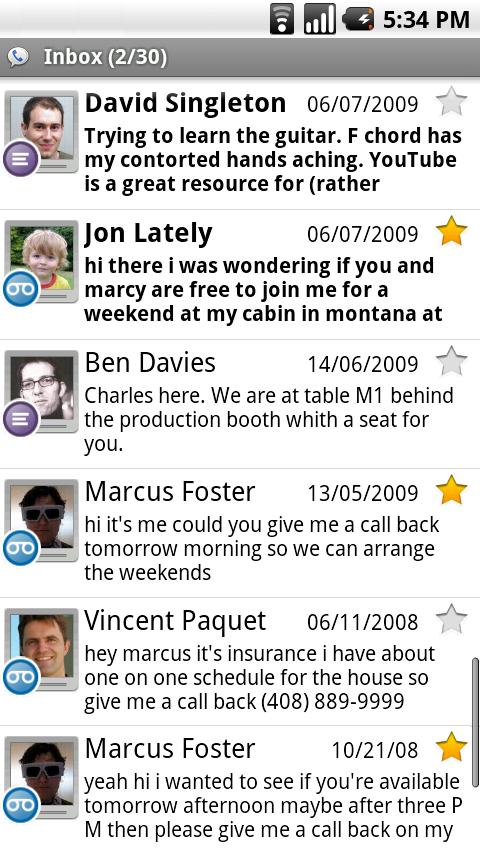
Lastly, the setup process will take you to your Google Voice Inbox. Here you'll see all transcribed voicemail, as well as any text messages sent to your Google Voice number.
The voicemail inbox in Google Voice for Android.Your voicemail inbox in Google Voice for Android.
iOS: Google Voice for iOS is different from Google Voice for Android, because Google Voice is confined to an app in iOS, whereas in Android it's integrated with the entire phone operating system. Once you've installed Google Voice for iOS, tap the app to open it. The app will prompt you to sign in using your Google account.
Signing in to Google Voice from the iPhone app.Signing in to Google Voice from the iPhone app.
Once you've signed in, the app will prompt you to add your phone number to your Google Voice account. If you add your phone number, you will be able to receive Google Voice calls on your mobile device. You may also decline to add a phone number.
The setup process will then take you to your Google Voice inbox, where you'll see all of your Google Voice voicemail and text messages.
You'll find four tabs in the Google Voice iOS app: Inbox, Dialer, Quick Dial, and Settings. You can make phone calls and send text messages using your Google Voice phone number. Phone calls will still count as phone calls on your mobile plan. Text messages, in contrast, will come from your Google Voice account (which is essentially a glorified Gmail account), so they will not count as text messages on your mobile plan.
In the Quick Dial tab, you can add favorite contacts and see recent calls. In the Settings tab, you can add phone numbers to your Google Voice account, add to your Google Voice balance, and turn on Click2Call.
Though Click2Call is a strange feature, it is useful in certain situations. With Click2Call, you can use a Wi-Fi or data connection to initiate phone calls on a nearby phone or computer. Such a function can be handy when you have a non-smartphone (associated with your Google Voice account), an iPod Touch, or an iPad (or an iPhone without a wireless plan), and you want to make a phone call via your Google Voice number. The only way to initiate a phone call from a non-smartphone is to use Click2Call from a smart device.

Using Google Voice

Google Voice is a practical application--if you know how to use it. However, it isn't a free-calling app (though if you use the desktop client, you can make free calls to U.S. numbers); it's just a way of streamlining your phone numbers and voicemail.
Google Voice uses your mobile device's minutes plan to make phone calls (if you don't have a minutes plan, you can't make calls), so it doesn't offer a way around carrier charges. Google Voice is useful if you want to read your voicemail just as you do email, send text messages for free, and consolidate your phone numbers. The ability to call using your Google Voice number is particularly convenient if you are a small-business owner and you don't want to give out your personal number to customers, or if you have multiple phones.

LAST


Sphere: Related Content
26/10/2008 free counters

The Koch Brothers People & Power


People & Power asks if the tycoon duo's fortune could put the radical right into the White House.
Last Modified: 27 Oct 2011 14:33


By People & Power reporter Bob Abeshouse
Charles and David Koch are each worth about $25bn, which makes them the fourth richest Americans. When you combine their fortunes, they are the third wealthiest people in the world. Radical libertarians who use their money to oppose government and virtually all regulation as interference with the free market, the Kochs are in a class of their own as players on the American political stage. Their web of influence in the US stretches from state capitals to the halls of congress in Washington DC.
The Koch brothers fueled the conservative Tea Party movement that vigorously opposes Barack Obama, the US president. They fund efforts to derail action on global warming, and support politicians who object to raising taxes on corporations or the wealthy to help fix America’s fiscal problems. According to New Yorker writer Jane Mayer, who wrote a groundbreaking exposé of the Kochs in 2010, they have built a top to bottom operation to shape public policy that has been "incredibly effective. They are so rich that their pockets are almost bottomless, and they can keep pouring money into this whole process".
Koch industries, the second largest privately-held company in the US, is an oil refining, chemical, paper products and financial services company with revenues of a $100bn a year. Virtually every American household has some Koch product - from paper towels and lumber, to Stainmaster carpet and Lycra in sports clothes, to gasoline for cars. The Koch’s political philosophy of rolling back environmental and financial regulations is also beneficial to their business interests.
The Kochs rarely talk to the press, and conduct their affairs behind closed doors. But at a secret meeting of conservative activists and funders the Kochs held in Vail, Colorado this past summer, someone made undercover recordings. One caught Charles Koch urging participants to dig deep into their pockets to defeat Obama. "This is the mother of all wars we've got in the next 18 months," he says, "for the life or death of this country." He called out the names of 31 people at the Vail meeting who each contributed more than $1m over the past 12 months.

In the 2010 congressional elections, the Kochs and their partners spent at least $40m, helping to swing the balance of power in the US House of Representatives towards right-wing Tea Party Republicans. It has been reported that the Kochs are planning to raise and spend more than $200m to defeat Obama in 2012. But the brothers could easily kick in more without anyone knowing due to loopholes in US law.
The Kochs founded and provide millions to Americans for Prosperity, a political organisation that builds grassroots support for conservative causes and candidates. Americans for Prosperity, which has 33 state chapters and claims to have about two million members, has close ties to Tea Party groups and played a key role in opposing Obama's health care initiative.
This year, Americans for Prosperity spent at least half a million dollars supporting Wisconsin Governor Scott Walker's efforts to cut social spending and roll back collective bargaining rights for public employee unions. The legislation passed by Walker makes it more difficult for unions, which are major backers of Democratic candidates, to secure funds for political purposes. Americans for Prosperity is also very active in a battle against unions in Ohio, another important 2012 presidential state. Its president, Tim Phillips, says that the organisation is winning in Wisconsin and around the country "because on the policies of economic freedom, we're right". He refused to tell People & Power reporter Bob Abeshouse how much the organisation is spending to combat the unions.
The Kochs have also poured millions into think tanks and academia to influence the battle over ideas. According to Kert Davies, the director of research for Greenpeace in the US, the Kochs have spent more than $50m since 1998 on "various front groups and think tanks who ... oppose the consensus view that climate change is real, urgent and we have to do something about it". As operators of oil pipelines and refineries, the Kochs have opposed all efforts to encourage alternative sources of energy by imposing a tax on fossil fuels.
Patrick Michaels, a senior fellow at the CATO Institute, often appears in the media to contest global warming science. CATO was founded by Charles Koch, and the Kochs and their foundations have contributed about $14m to CATO. Since 2009, there has been a sharp drop in the percentage of Americans who see global warming as a serious threat according to Gallup polls. Davies argues that the change can be attributed in large measure to the efforts of scientists like Michaels and others who are funded by the fossil fuel industry.
The Kochs have also promoted their free market ideology and business interests through aggressive lobbying in Washington DC, and financial support of political candidates. Greenpeace has tracked more than $50m that Koch Industries has spent on lobbyists since 2006, when Cap and Trade and other legislation to combat global warming was being considered. The Kochs have been the largest political spender since 2000 in the energy sector, exceeding Exxon, Chevron, and other major players.
The Kochs contributed to 62 of the 87 new members of the US House of Representatives in 2010. Members of the House Energy and Commerce Committee that the Kochs supported have taken the lead in opposing US Environmental Protection Agency efforts to reduce global warming emissions. Other members backed by the Kochs belong to the right-wing Tea Party bloc that took the US to the brink of default in July by refusing to consider a budget deal that would include tax increases.
In 2012, many believe that President Obama can raise a billion dollars for the presidential race, and break all fundraising records. But as Lee Fang of the Center for American Progress tells reporter Bob Abeshouse, in the end it may not matter "because the Koch brothers alone increased their wealth by $11bn in the last two years".

LAST


Sphere: Related Content
26/10/2008 free counters

Bill Gates On “The Miracle Of Availability” And Applying Computer Science To The World

gates1
Bill Gates just gave a talk at the University of Washington’s School of Computer Science and Engineering. As is typical of his talks, this one was broadly focused on new and helpful implementations of technology. It was followed by an open Q&A session.
There was nothing radical or new proposed or revealed, but Gates was smart and compelling as usual, and the highlights of the talk are below. Video of the talk should be available soon from UW.
I’ve tried to directly quote Bill as much as possible (bolded for those hungry for sound bytes), but there may be small errors in phrasing. If it’s in quotes, it’s his words, though I may need to correct a few words here or there.

“Maybe I’d have been more rounded if there weren’t as many books around”

Gates began by establishing his computer science credibility, not that it’s necessary at this point, by reminiscing about the early days of computing. He recalled that at UW, “at strange hours you could essentially break in and steal computer time,” on the batch-work computers of the day like the B5500. This served as a segue, actually, to his initial thesis, which was that people like himself aren’t the ones who will bring be making the next generation of breakthroughs happen.
He cited the incredible amount of storage and its almost negligible cost, and how as someone who grew up with kilobytes and megabytes, he simply isn’t ideologically suited for allocating terabytes and petabytes. But people who have grown up with it do things like, for example, suggest that every lecture at a university be recorded and stored. Once he got past the prejudice of someone who wants to save every byte, he said he thought “it’s actually kind of absurd that we’re not doing that.”
The big advance, Gates said, is “the miracle of availability.” This is the change that happens when something goes from being a device owned by the elite and wealthy of the world to being something utilizable by the poorest. An example given later was the sophisticated GPS-driven combines used on US farms. Ingenious, but can you build one that an African village can afford?
As a further example, he showed off an application using the Kinect which I actually highlighted back in August. Not that it would be useful to a starving child, but there is a huge potential just waiting to be unlocked, as Microsoft Research and innumerable hackers have shown for the Kinect and other devices.

“Many problems in society are just poorly designed algorithms”


Gates praised alternative models for education, showing off a program for teaching algebra that actively monitored how the student was doing, what methods of teaching worked, and adjusted the lessons on the fly. We saw some other ideas along this line with the Imagine K12 companies, which I’m sure Gates would appreciate if he is not already aware of them.
He also spoke in glowing terms of Khan Academy, which we’ve featured here quite often. But, as he later elaborated during the Q&A session, it’s not meant to be a substitute for learning institutions. “As you go from Kindergarten to college, hopefully the need for adult supervision goes down somewhat, but there’s still a need for guidance.” He noted that some 20 schools had completely reorientated their curricula around Khan Academy and similar services, with the teacher assigning the lectures and quizzes to be watched on the student’s own time, and then using the classroom not as a lecture hall, but as a discussion platform that added context, clarified points, and offered more one on one time for students who couldn’t grasp the material.
As for adding computer science to the curriculum as early as elementary school, he was skeptical: “I think the computer is a great tool and you should use it as much as you can. But hash tables and database indexes, I don’t know where that would come in… It’s hard to say anything is necessary in the curriculum. Personally, I’d have more people take statistics than calculus.”
But though he spoke lightly of it, he really considers education one of the highest priorities. When asked how he felt about political discourse and the concentration of wealth, he responded that, to put things in perspective, “the number of people in abject poverty is the lowest in history.” But that said, “It’s not good to have a society where you don’t have mobility between different income levels. If you really look where we’re letting people down as far as the American dream… it would be that we are not providing enough education.”
Without proper education, how can people make rational choices in day to day life, to say nothing of the issues voters face? “One thing I’m worried about is complexity. We can’t talk directly about the issues, so we talk about personalities.” When the most controversial bill of a political era (Obama’s health care bill) is over four thousand pages long and totally unreadable by the average voter, how is that effective?

“I like hash tables and I dislike malaria”

He then moved on to the question of poverty and disease. His primary insight came when he was working with researchers to create a stochastic model of “one of my reactors.” It was immensely complicated but the computing power at their disposal made it possible. He thought, if we can model a reactor, with all these forces and materials, why can’t we model disease, including the mosquitos, the people, the environment, the solutions?
So they worked at it and eventually came up with an immensely complex model for disease vectors, weather, vaccines, life cycles, seasons, and everything else. They compared it with real statistics and it checked out. He said with confidence: “The world effort to get rid of malaria will be based on this model.” And the modeling approach to problems, now that we have the computing power to simulate the world with some precision, is just as important to apply elsewhere. Whether it’s malaria, polio, crops, nuclear reactors, sanitation, or education, “it makes you so much more rational in terms of what you do.”
He demonstrated a few applications of the model and explained quite a bit about the disease itself and some of its history. But you can learn about malaria on your own time.

“It’s the same hamburger”

On the topic of wealth, something in which he must be considered something of an expert, he downplayed the money thing. One questioner asked for advice on getting as rich as him. He took this slightly tactless question in stride, saying that he never intended to become extremely wealthy, and that it was more important to do something you were interested in. He also said that while he understood the drive to make a few million dollars, a level of wealth that provides “meaningful freedoms,” after that amount, “it’s still the same hamburger. Dick’s hasn’t raised their prices enough…” This raised a laugh from the audience, who are probably all too familiar with Seattle’s local burger joints.

“All you’re trying to do is put stuff on your eye”

When asked what might come after the change from PC to laptop to smartphone, he was animated: “We’re going to look back and laugh that we had these big glass screens, and if you drop it, it breaks… all you’re trying to do is put stuff on your eye!” As in, it’s just a way of getting information from the world into your brain, via your eyes. He suggested that projection directly onto the retina was likely the next big step, or alternatively a flexible screen of adjustable size.

Lastly, the host noted that it would be Bill’s birthday tomorrow (the 28th), and invited Bill Gates Sr. up on stage, who held a cupcake with a candle for the younger Bill to blow out.
If you’re interested in the continuing adventures of Bill Gates, you can keep up with him at The Gates Notes.

LAST


Sphere: Related Content
26/10/2008 free counters

BlackBerry maker parts ways with another top manager


Blackberry devices are displayed at a release party to promote the BlackBerry OS 7 devices in Toronto August 3, 2011.  REUTERS/Mark Blinch

TORONTO | Thu Oct 27, 2011 10:07pm EDT
(Reuters) - Research In Motion has parted ways with a senior executive involved with the company's move into "cloud-based" services, adding to a string of high-level departures from the BlackBerry maker.
Jim Tobin, senior vice-president for software and business services reporting directly to co-CEO Jim Balsillie, left the Canadian company months ago, RIM confirmed on Thursday in an email. It has never officially announced the departure.
His exit further depletes a management team that has lost a number of top executives in developer relations, sales, and marketing in recent months.
The attrition comes as the smartphone maker struggles to regain its competitive edge against Apple Inc's iPhone and iPad and a slew of devices using Google's Android software.
RIM has repeatedly delayed its new product releases, and once launched, some of its devices have received poor reviews. Earlier this month a global outage knocked out service for tens of millions of BlackBerry users across five continents.
In July RIM said it was slashing about 11 percent of its workforce because of falling sales and profit.
Tobin was responsible for a recent move by RIM into cloud services - allowing its enterprise customers to use servers hosted by RIM instead of on-site computers to handle email and other corporate data.
He also worked on a team that developed BBM Music, a song-sharing service run on top of RIM's popular BlackBerry Messenger application as well as a wider push to incorporate Messenger into third-party developer applications.
Tobin previously worked in product development at Comcast, and at Time Warner in a corporate technology role. He was an associate principal at consulting firm McKinsey, according to his LinkedIn profile, which still shows him as a RIM employee.
RIM has parted ways with a string of high-profile employees in recent months, including chief marketing officer Keith Pardy and head of developer relations Tyler Lessard.
One of RIM's three chief operating officers, Don Morrison, resigned in July after taking a medical leave.
Two members of Pardy's team later left for jobs with rival Samsung, while a member of Lessard's developer outreach unit, Mike Kirkup, resigned in August.
A growing chorus of investors and analysts are calling for a shake-up at the very top of the company, where co-founder Mike Lazaridis and long-time partner Jim Balsillie share roles as chief executives and chairmen of the board.
RIM's shares have lost some 70 percent of their value since a peak around $70 reached in February. They were trading 2.5 percent higher at $21.24 on the Nasdaq by early afternoon on Thursday.
(Editing by Frank McGurty)

LAST


Sphere: Related Content
26/10/2008 free counters

FX Networks Mad About Charlie Sheen's Anger Management, Picks Up Series

Charlie Sheen Christopher Polk/Getty Images
Coming soon to a television near you...
After numerous pitch meetings in New York and Los Angeles for his proposed new sitcom, based loosely on the Jack Nicholson-starring comedy movie, Charlie Sheen's Anger Management has been picked up by FX.
John Landgraf, President and General Manager of FX Networks, announced today that they have ordered 10 episodes of the show, which will air in the Summer of 2012.
READ: Does Charlie Sheen Make Money on Charlie Sheen Halloween Masks?
"We think that Bruce Helford, Joe Roth and Charlie Sheen have come up with a wonderful, hilarious vehicle for Charlie's acting talents—and a character we are very much looking forward to seeing him play," said Landgraf.
"Two and a Half Men has been an outstanding component of FX's schedule for the past 14 months, and we have every confidence that Anger Management will soon be as well."
The release describes the sitcom as, "an anger management therapist [Sheen], who may need more counseling than his patients, wreaks havoc on the lives of his patients through his unconventional methods."
So how do some of his soon-to-be collaborators feel about Mr. Tiger Blood?
"I have been fortunate to work with Charlie Sheen on six hit films," said Roth. "Now to have Charlie, the number one comedy star on TV, doing Anger Management, feels like a perfect fit."
We know it's so cliché now, but "winning!" seems appropriate.


LAST


Sphere: Related Content
26/10/2008 free counters